WELCOME! Join me on my journey as I prepare for and then travel to Belize City, San Pedro Town, and San Ignacio in Belize and then to Tikal, Guatemala.

Sunday, April 17, 2011

Sunday 4-17 Heading to the ATM Caves

In the previous Belize Zoo/TEC post I failed to provide any information about our bus driver/tour guide. His name is Manuel, a short stocky Belize native who appears to be in his late 30s or early 40s, is married and has three sons. Manuel is a very intelligent individual who speaks English with with a heavy Belize accent but has excellent enunciation, pronunciation, and vocabulary. He has a deep rich voice and when he speaks he sounds like he should be narrating a National Geographic special. A bus driver/tour guide is really a prestigious job in that country that requires rather rigorous schooling and licensing. Anyway, more about Manuel later.

I woke up at the Tropical Education Center just after sunup, took a cool shower to get my blood pumping, and then loaded my things into my back pack. Our group was scheduled second for breakfast at 7:15 so I went to the chow hall just for a cup of coffee. I took my coffe and went for a walk about down the long winding road that leads back to the entrance of the TEC. I was keeping my attention focused for any wildlife, especially birds. There is an observation deck at the TEC building that has pictures and descriptions of all the species of birds that habitate the area. When I reached the entrance to the TEC, I stopped to sip my coffee and look into the brilliant blue morning sky. A raucous noisy caught my attention, and I spotted a large black bird heading my way. The bird landed in the top of a pine tree not far above my head. It was a Toucan! We stared at one another and had a conversation that lasted I'm not really sure how long. When he was finished he flew away as effortlessly as he flew in, and for awhile, took me with him. Man, I wish I could do that.

After breakfast, we loaded up the bus and headed for the Actun Tunichil Muknal (ATM) cave that is also locally known as "Xibalba."
We left the TEC and headed further west into Cayo. The bus turned of the main road and slowly traveled for several miles down a long, curvy, bouncy, deeply rutted, dirt and rock road. Once we arrived, we ate a bag lunch and then began the hike for miles into the jungle and had to cross several streams to reach the cave. Once there, we were each given a hard hat with a light and had to check the lights to make sure the batteries were charged and replaced them if needed.
Feels like we're on Survivor Island.
What a dork! 
From this point it was a short walk and a brief climb down some rocks to the mouth of the cave. There are two ways to enter the cave; either swim in through the mouth here or rapel down a 300' drop in the middle of the cave. Once we were inside the cave, Manuel asked that we maintain an air of reverence and respect. I have video of this trip that I will try to post at some point.
Chilly water!


As we traveled through the caves we were often in knee deep to chest deep water and at times were squeezing our bodies between jutting rocks to get further into the cave. The areas where artifacts were located are considered sacred. We had to remove our shoes so as not to damage any of the area and walk sock-footed so that the oils in our skin would not come in contact with the limestone floor or anything else. Nothing could be touched. They are insistent that no artifacts be removed from the cave by archeologists or anyone else. What is there belongs there and should stay there. I think if the cave were in other parts of the world, the artifacts would be removed and put into a Museum. The Belize Tourism Board grants licenses to only a few agents to conduct tours in the cave.

Inside the cave: That is Manuel to the far right at the front of the group. The only light in the cave was from Manuel's flashlight or the lights on our hard hats. There were times that all hard hat lights were turned off. There was only Manuel and his deep rich baritone voice describing a scenario. Almost like an ancient god's voice speaking in the darkness. Really cool.


The next pictures will be of pottery vessels that were left in the caves. Many were said to have held human blood for sacrifice to the rain god who was believed to dwell in the cave. Women would pierce their tongues and drain the blood into vessels and men would cut their genitals and drain blood into the vessels. 

If you look closely, you can see a special symbol on this vessel.
The last area that we entered is known as the cathedral. It is a small area carved high into the cave. To reach there, we had to climb a very tall ladder.
Liability issues would never allow this in the U.S.

Before you go to the next pictures, I ask that you view them with respect and reverence and say a blessing for them.

It was an amazing experience knowing I was standing and breathing where ancient Mayans had walked and held their rituals. Manuel disagreed with some archeologists interpretations of the Maya culture and called it BS.  He is very proud of the heritage and history of his country.
We had to exit the same way we entered, back through the cave and the water. The trip out was much more silent than the trip in.

Saturday, April 16, 2011

Sat. 4-16 Evening-The Tropical Education Center

We arrive at the TEC after turning of the highway and traveling a couple miles down a winding road through the jungle.
Nice to know!
The entrance.
Our fearless leaders discussing housing arrangements (Dr. C.-facing camera, Dr. K-wearing hat, Dr. R.-white T shirt, gentleman in red shirt works at TEC).
The cabin that I slept in. There are two separate rooms with two beds in each room.
My bed. I slept like a rock!
There is no plumbing in the cabins.
The outhouses are in one location.
The showers in another location.
And, the sinks are in yet another location!
Well, I think we have everyone somewhere to sleep!
The upstairs in this building is where educational sessions are held. The bottom level is the cafeteria area.


Sat. 4-16 Heading to the Tropical Education Center and the Zoo!

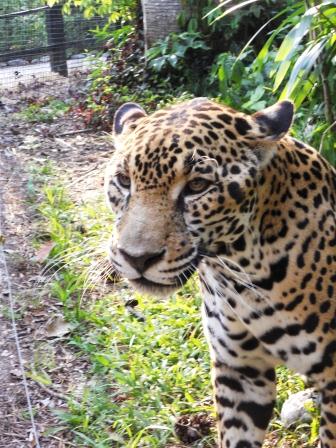
We arrived at the Tropical Education Center [TEC] in the afternoon (4-16). To get to there, the bus driver turned off the paved road and drove about two miles down a dirt and rock road that was sun baked and dusty and across a couple of small wooden bridges into the TEC. We notified them that we had arrived, got back on the bus, drove back to the paved road, and drove to the Belize Zoo a few miles away. You might think that because we were at a zoo that we were in an urban area. No way! We were in the middle of nowhere. The zoo is located down a dirt and rock road nestled in the bush. This is not your typical zoo. It is very modest. There are no cages except for the poisonous snakes. The animals are basically in natural habitat areas that have been surrounded by fence to keep the people out. What is interesting is that unlike most zoos where animals are in cages, these animals can come right up to the fence and reach out and grab you if you get to close. There is a wood rail about 18 inches in front of the fence and about 24 inches high as you walk the trails to discourage people from standing next to the fence. I think the best deterrent is the sign at the entrance that says, “Beware. Keep all body parts behind wood barrier.” After walking the trails for quite a while, we met one of the wildlife keepers, a native Belizean, carrying a small plastic container. We began talking with him, and he took us to various areas where he called to the animals. I mean called to them in their language. He could call the Howler monkeys and the big cats. He gave the Howler monkeys peanuts and they took them right out of his hand.  He then took us to areas where different species of big cats lived. We saw pumas, ocelots, and jaguars. The wildlife keeper fed them small pieces of chicken parts from the plastic container so that we could take pictures. The chicken parts still had the bones in them, and you could hear the powerful jaws of the cats crunching through the bones. The amazing part of the experience was that we were less than two feet away from the cats. I didn’t want to take pictures of these beautiful animals with fence in front of them, so I would lean over the rail and stick my camera lens through the fence. This worked great. I was getting real up close pictures until the jaguar decided I was a threat to his chicken and growled and took a little swipe at me. He was not trying to harm me in any way. It was just his way of saying, “Hey, this is my chicken, and I’m not sharing.” What an amazing experience to be that close to such a huge powerful beautiful animal.
But, I believe the highlight of this visit to the zoo was the wildlife keeper. His knowledge of each of the animals was incredible. What was more incredible was his love for these animals and his pride that they represented his country of Belize. The animals that live at the Belize zoo are not captured and brought there. The animals that live there were orphaned, rescued, or rehabilitated after injuries. This wildlife keeper shared the story of each animal, most of whom he personally treated, nursed, or raised from an infant. You could see the love and pride in his eyes and hear it in his voice as he shared each story. I would say something like, “What a wonderful experience that must have been!” and he would nod his head yes and a beaming smile would spread across his face. I not only could see his love and pride for these animals, I could feel it.

We took the water taxi from San Pedro to Belize City where we boarded a bus and headed west to the Belize Zoo.
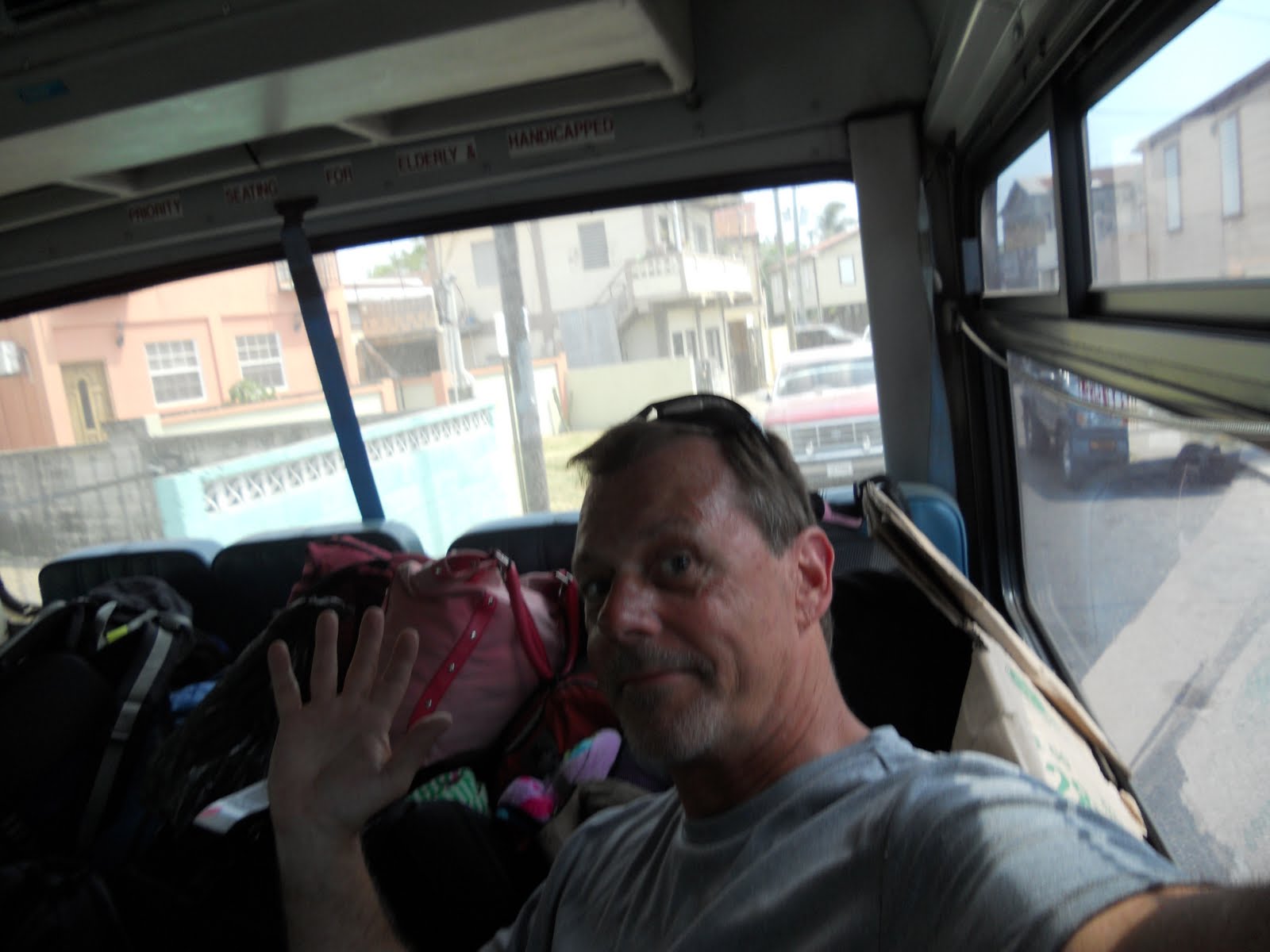
This is me in the back of the bus with the luggage.
Nick and Kyle.
Arriving at the zoo. Not your typical zoo. It's more like a wildlife rescue operation.
A tapir which is a national symbol of Belize.
A tapir up close and personal.
A crocodile.
Endangered vulture.
Monkeys coming to visit.
Endangered Harpy Eagle.
You could never get this close to wild animals in a zoo in the U.S.

Going to see the big cats.
They are not kidding.
This jaguar is actually standing on top of a cage. There are people inside the cage-interesting turn of events.
A jaguar eating chicken parts.
A jaguar up close and personal. His ears are back. He's not intereseted in sharing his chicken.
The jaguar letting me know that I was getting too close to his chicken!

Friday, April 15, 2011

Friday 4-15 (after soccer game) Alex and the lucky seed necklace.

This is Alex. Alex earns money making necklaces, bracelets, and anklets for tourists.  He has a charming personality and could make a ton of money in the U.S. as a salesman. Alex is a math whiz when it comes to counting money and conversion rates. Alex's goal is to become a veterinarian. He has a true passion for animals, especially dogs. I pray he achieves his dreams.


I met Alex several days earlier when he was trying to sell me a necklace during dinner one night at a restaraunt. I didn't buy one. I asked him to sit with me and talk for awhile. He's a pretty cool kid. Before I left, I asked him if he would custom make a necklace for me. He said he would, and that he would meet me at the soccer game Friday night where some of our UNCW interns and teachers at the school were scheduled to play against the parents. I didn't tell him what I wanted. I just asked him to make one especially for me.
This is Alex and me making our transaction. He made me a necklace with brown and tan wood beads and a large "lucky seed." I asked him why they were called lucky seeds, and he said the seeds float on the currents all the way from Africa. I wear the necklace from time to time back here in the states when I need a little Caribbean luck.

Friday night 4-15 The soccer game.

During this week, there were two soccer games scheduled. The first game was the fathers of students against the male teachers and male UNCW interns. The second game was the mothers of students against the female school teachers and female UNCW interns. I misssed the first game, so I wanted to be sure to make it to the ladies' game. It was a very exciting and close game. The parents were victorious with a score of 3-2. What was amazing about the experience was the large crowd that turned out for the game: moms, dads, students, grandparents. There is a real sense of community and support for extracurricular activities. A true atmosphere of acceptance was felt when a large part of the crowd was cheering for the team comprised mostly of our lady UNCW interns. Just a heartwarming experience altogether.

Lesley, third from left and facing forward, is one a member of my doctoral cohort. The other three ladies are UNCW interns.
Jessie, UNCW intern, advancing the ball toward the goal.